Where Should You Host Your App? Hosting Providers Compared
So… You built your app. It works. It’s cool. Now the big question, where the heck should you host it? We get it. Hosting is no longer just about throwing code on a server. It’s about choosing the right setup, at the right cost, with the right performance for your users. Let’s break it down.

5 min read


So… you built your app. It works. It’s cool. Now the big question—where the heck should you host it?
We get it. Hosting is no longer just about throwing code on a server. It’s about choosing the right setup, at the right cost, with the right performance for your users.
Let’s break it down.
🧠 First, Know the Types of Hosting
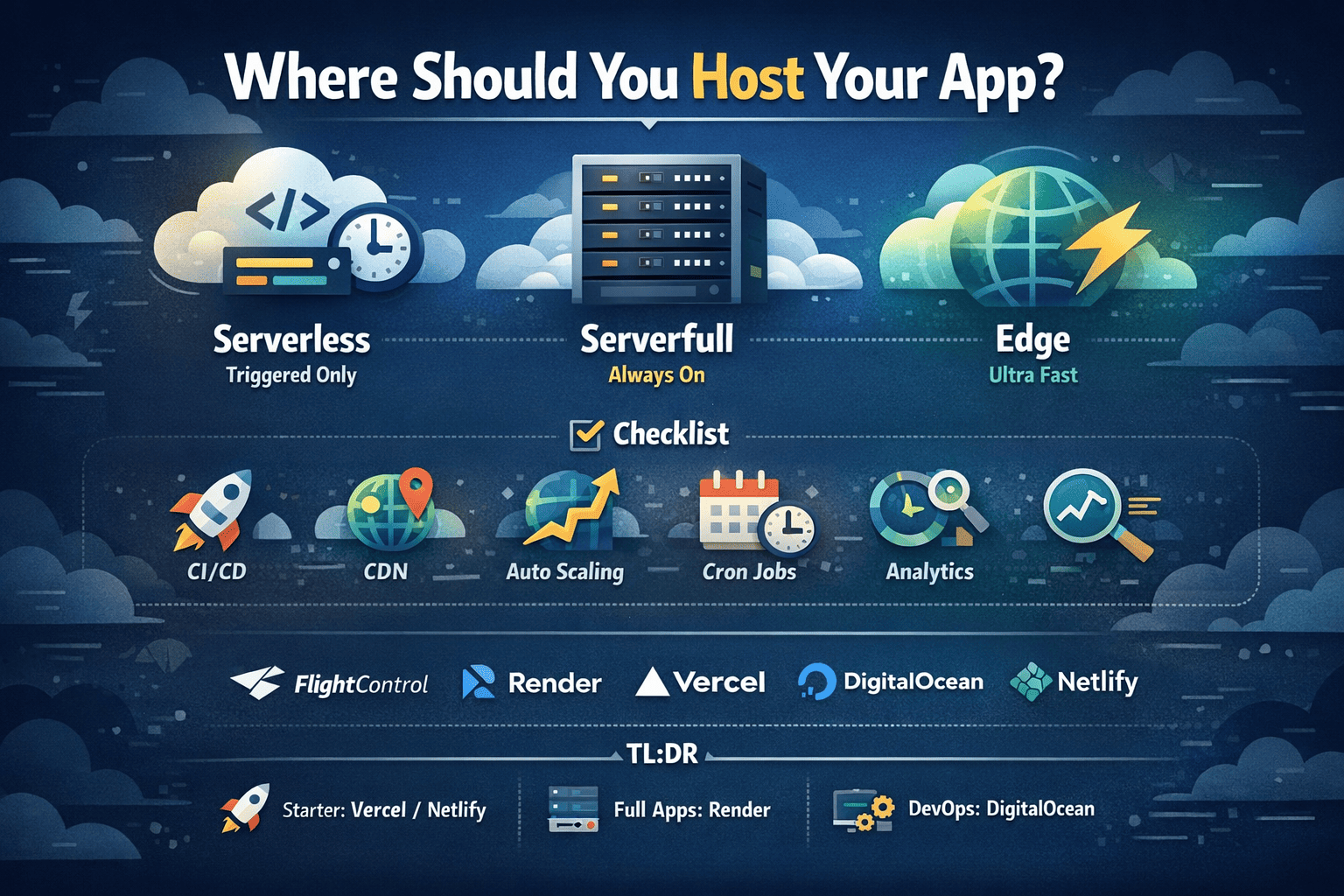
Before comparing providers, let’s quickly go over the three main hosting types you’ll run into:
1. Serverless
- Code lives inside functions.
- Runs only when triggered.
- Great for scaling fast and saving on idle costs.
- Example use case: a monthly PDF report generator.
2. Serverfull (a.k.a. traditional VM or container hosting)
- Long-running servers that stay active.
- More predictable. Better for real-time apps or heavy processes.
- You pay for uptime, not usage.
3. Edge
- Like serverless, but runs closer to the user (think: CDN for functions).
- Super low latency.
- Limited APIs compared to full Node.js.
💡 Add These to Your Hosting Checklist
Every provider might throw around features. Here’s what actually matters:
- CI/CD: Can you push code and auto-deploy?
- CDN: Is content served near your users?
- Scaling: Does it scale automatically? At what cost?
- Cron Jobs: Can you run scheduled tasks?
- Preview Deployments: Can teammates preview each pull request?
- Billing Model: Are you paying for runtime (serverless), compute time (CPU), or server size (VM)?
- Analytics: Do you get insights into traffic, function runs, or errors?
🔍 Hosting Providers Reviewed
Let’s talk options. We’ll cover the good, the bad, and the opinionated takes from the Syntax crew.
FlightControl
- Built by the creator of Blitz.js.
- Think of it as a Vercel-like control panel for your own AWS.
- You’re using your AWS account, not theirs.
- Uses CloudFormation and Nixpacks.
- Pricing is a percentage of what you spend on AWS AMS.
✅ Great for AWS power users who want ease
❌ Requires AWS knowledge to start
Render
- Serverfull hosting. Think: long-running Node apps.
- Good support for Redis, Postgres, workers, and cron jobs.
- CI/CD, deploy previews, and custom scaling.
✅ Great for Node apps
✅ Easy to set up and scale
❌ Slightly unstable during instance migrations (watch your node versions)
Vercel
- The go-to for Next.js and modern React apps.
- Mix of serverless (Lambda) and edge (Cloudflare Workers).
- Killer DX (developer experience), fast builds, and global CDN.
✅ Seamless Git integrations
✅ Fast, optimized builds
✅ Solid analytics
❌ $20 per team seat can get pricey
Begin
- Started as a serverless CI tool, now does full-stack with web components.
- Uses open standard ARC.
- Focused on AWS under the hood.
✅ Great for quick serverless endpoints
✅ Lightweight and fast
❌ Niche setup—might not be for everyone
Heroku
- Once the king. Now… kinda ghost town.
- Bought by Salesforce. Progress? Meh.
- Free tier gone. Downtime more common.
✅ Easy to get started (back in the day)
❌ Outdated features
❌ Not recommended for new projects
DigitalOcean
- Known for their $5 droplets (VPS servers).
- Full control with CLI and UI.
- Also has an App Platform (but… meh).
✅ Perfect if you want hands-on Linux access
✅ Good docs and community
❌ App platform can be buggy
❌ Requires DevOps knowledge
Linode (now Akamai)
- Similar to DigitalOcean.
- Fully rebranded under Akamai for edge services.
- Trusted and reliable VPS hosting.
✅ Longstanding reputation
✅ Powerful VPS management
❌ Less community buzz after rebrand
Netlify
- The OG of free static site hosting.
- CI/CD, preview URLs, and functions built in.
- Recently rebranded (yeah, the logo’s polarizing).
✅ Best for static sites and JAMstack
✅ Smooth developer experience
❌ Limited when you need full backend control
💸 Pricing Breakdown Cheat Sheet
| Provider | Billing Model | Free Tier? | Great For |
|---|---|---|---|
| FlightControl | % of AWS usage | No | Full control on AWS |
| Render | Serverfull, per VM | Yes (limited) | Node apps, backend services |
| Vercel | Serverless/Edge | Yes (generous) | Next.js, frontend heavy apps |
| Begin | Serverless | Yes | Quick APIs, web components |
| Heroku | Per dyno (VM) | No | Legacy apps (not recommended) |
| DigitalOcean | Per VPS | No | Custom setups, control freaks |
| Linode | Per VPS | No | Infrastructure-heavy projects |
| Netlify | Serverless/static | Yes | Static sites, frontend devs |
🧠 TL;DR – So, Which Should You Pick?
- Beginner? Go with Netlify or Vercel.
- Building a full Node app? Use Render.
- Want full cloud power without AWS pain? Try FlightControl.
- Old-school Linux pro? Stick with DigitalOcean or Linode.
- Serverless-only? Check Begin or Cloudflare Workers.
- Avoid? Sadly, Heroku.
Choose what fits your project and your future plans. Because moving providers later? It’s not always fun.
Let your app live where it runs best.
🚀 Let’s build something amazing! If you have a project in mind or need help with your next design system, feel free to reach out.
📧 Email: safi.abdulkader@gmail.com | 💻 LinkedIn: @abdulkader-safi | 📱 Instagram: @abdulkader.safi | 🏢 DSRPT
Drop me a line, I’m always happy to collaborate! 🚀
Last updated 17 Jul 2026