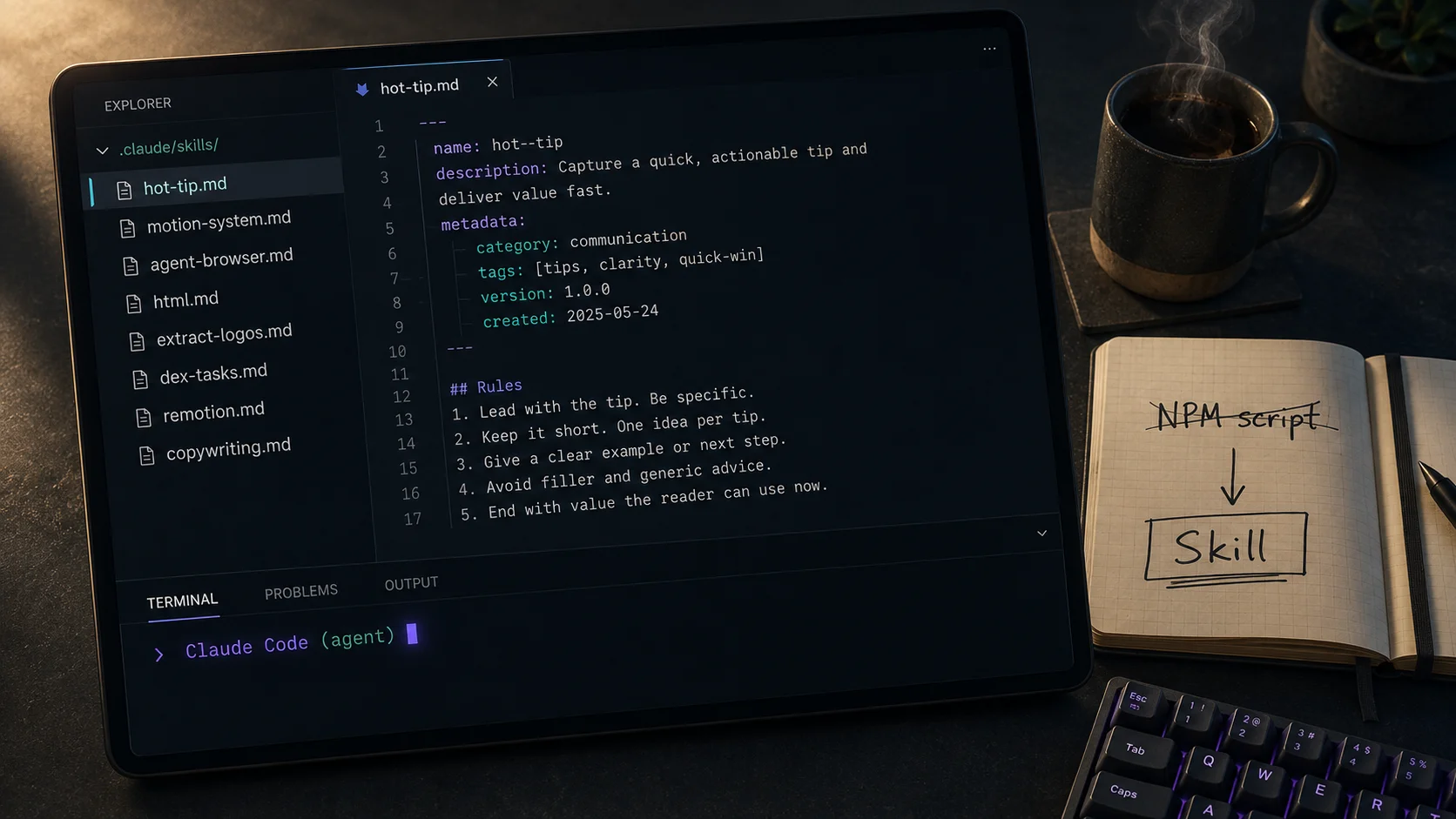
Claude Cowork vs OpenClaw vs Hermes Agent: Honest Pick (2026)
I ran the same workflow through Claude Cowork, OpenClaw, and Hermes Agent. One of them is worth your money. The other two might be worth more, depending on what you actually want.

9 min read



Three weeks ago, a client asked me to pick "the best AI agent" for their ops team. Sounds simple. It wasn't.
I ended up running the same brief — "clean up our HubSpot, write a brief on every churned account from Q1, and draft re-engagement emails" — through Claude Cowork, OpenClaw, and Hermes Agent. Same brief. Three very different outcomes. Three very different bills.
Here's what I found, with zero marketing copy.
TL;DR — Which One Wins?
Short version, before the deep dive:
- Claude Cowork → best if you want it to just work. Non-technical user, desktop apps, no infra. Pay-and-play.
- OpenClaw → best if you'd rather own everything. Self-hosted, no per-seat pricing, you pick the model.
- Hermes Agent → best if you want an agent that actually learns you. Runs on a $5 VPS. Open-source. Persistent memory.
If you stop reading here, that's the answer. Below is the why — and the part most reviews skip: where each one quietly falls apart.
What Each One Actually Is (No Spin)
A lot of "comparison posts" never define the things they're comparing. Skip that.
Claude Cowork
Claude Cowork is Anthropic's desktop agent built for knowledge workers — marketers, ops, researchers, founders. It's the sibling of Claude Code but pointed at non-engineers. Give it a goal, it works on your computer, opens your files, moves between apps, and hands back a finished deliverable.
It's closed-source, runs as a desktop app, and bills per seat. Multi-agent orchestration is built in — one Claude can spin up other Claudes, divide a task, and synthesize results. Released as part of Anthropic's broader "agentic AI" push earlier this year.
OpenClaw
OpenClaw is an open-source agent framework with 199K+ GitHub stars. It runs on your own hardware — local machine, VPS, GPU box, doesn't matter. You wire it up to Claude, GPT-4o, Gemini, or local models via Ollama. Skill-based architecture: agents are made of small, reusable capability modules you can drop in.
No per-seat pricing. No SaaS lock-in. Your data, your hardware, your rules. Trade-off: you set it up.
Hermes Agent
Hermes Agent is from Nous Research, dropped in February 2026, and crossed 140K GitHub stars in three months. The pitch: it grows with you. Built-in learning loop, persistent memory across sessions, creates its own skills from experience, and runs on anything — a $5 VPS up to a GPU cluster.
According to OpenRouter, it's currently the most-used agent in the world. That's not a small number.
My 47-Minute Test: Same Job, Three Agents
I gave each one the same HubSpot brief. Here's what happened.
Claude Cowork finished in 18 minutes. Zero setup. I literally clicked open the desktop app, dropped the spreadsheet in, typed the brief, walked away. Output was clean — almost too clean. Re-engagement emails were polished but felt like every other Claude-written email I've ever seen. No edge. No surprises.
OpenClaw took me 90 minutes — but only because I was setting it up from scratch on a fresh DigitalOcean droplet. Once running, the actual task took ~25 minutes. I wired it to Claude Opus 4.7 via API. Cost on the run: $0.84. The output was nearly identical to Cowork, which makes sense — same model under the hood. But now I owned it.
Hermes Agent took 22 minutes the first run, then 12 minutes the second time — because it remembered what "Q1 churned account" meant in our context. By run three, it was suggesting categories I hadn't asked for. That's the persistent memory paying off. The catch: I had to install it on a VPS and connect it to an LLM provider myself.
Three agents, three different feels. None of them was a clear winner across the board.
Where Claude Cowork Actually Wins
Don't dismiss the polished option just because it's polished.
- Zero infrastructure. No VPS, no API keys to juggle, no Docker. You install it, you sign in, you go.
- Desktop integration is real. It opens your spreadsheets, edits your slides, drafts emails in your actual mail client. Most "AI agents" can't touch your local files. Cowork can.
- It's the same Claude you trust. If you've used Claude.ai or Claude Code, the model behavior is consistent. No surprises.
- Multi-agent orchestration is invisible. You don't think about it. The orchestrator and sub-agents are just there. For non-technical teams, that matters more than the engineering blog posts admit.
- Backed by Anthropic's safety stack. Constitutional AI, alignment research, the whole pipeline. If you work in healthcare, legal, or finance — this matters.
Where it breaks: $25-$75 per seat per month depending on tier. You can't bring your own model. You can't run it air-gapped. And the desktop-only model means no headless automation — you can't drop it into a CI pipeline.
If you're a solo founder paying $25/month to save 10 hours, the math works. If you're rolling out to a 50-person ops team, do the spreadsheet first.
Where OpenClaw Quietly Wins
This is the option I'd default to if the team has even one technical person.
- You own everything. Your data never leaves your infra. For regulated industries — finance, healthcare, government — that's not a nice-to-have. It's the entire reason your project gets approved.
- No per-seat pricing. Pay for compute and tokens. That's it. A team of 20 can run on one beefy server.
- Model flexibility is the killer feature. Need Claude for reasoning, GPT-4o for vision, local Llama for sensitive ops? OpenClaw juggles all three in the same workflow.
- The skill ecosystem is real. 199K stars means there's a community-built skill for almost everything — Gmail, Slack, Notion, your weird internal API. If you've built MCP servers before, this will feel familiar. I covered the broader idea here → I Built an MCP Server for My Portfolio. Here's Why It Matters.
Where it breaks: the setup will eat half a day if you've never deployed a Node service before. The skills you install are only as good as the community that wrote them — some are excellent, some will leak memory at 3am. And there's no support team. You're the support team.
For me, this is the answer when the client has a budget but also has rules about data residency.
Where Hermes Agent Surprises
I want to flag this one because most comparisons skip it — and they're wrong to.
Hermes does something the other two don't: it learns you across sessions. Not "it remembers your name" learning. It builds a model of how you work, what context you skip, what you mean when you say "the usual report."
- Built-in persistent memory. Not a vector DB you have to maintain — it's baked in.
- Agent-created skills. It writes its own skills based on what you keep asking it to do. By week two, mine had created a skill called
weekly_client_digestI never asked for. It just noticed I ran the same prompt every Monday. - Runs anywhere. A $5 VPS handles a single user comfortably. Scale up when you need to.
- Provider-agnostic. Any OpenAI-compatible API works — Claude, OpenAI, OpenRouter, local models, doesn't care.
- CLI + Telegram + Discord + WhatsApp + ACP for editors. You can talk to your agent from any interface that fits the moment.
Where it breaks: the learning loop is the magic, but it's also the risk. If it picks up a bad habit early — wrong tone, wrong format — it'll keep doing the wrong thing until you correct it. Treat the first two weeks like onboarding a junior. And the "self-improving" framing is real but oversold — it improves within bounded tasks, not in the AGI sense some people read into it.
Hermes is the one I personally run on a side VPS for my own workflow.
The Pricing Reality
Let's put real numbers on it.
| Agent | Cost Model | Realistic Monthly Cost (1 user, moderate use) |
|---|---|---|
| Claude Cowork | Per-seat SaaS | $25–$75 |
| OpenClaw | Self-hosted + API tokens | $5 (VPS) + |
| Hermes Agent | Self-hosted + API tokens | $5 (VPS) + |
For 10 users, the math gets brutal:
- Cowork at $50/seat × 10 = $500/month
- OpenClaw shared on a $40 VPS +
$150 in shared tokens = **$190/month** - Hermes on a $40 VPS +
$120 in shared tokens = **$160/month**
Cowork's premium is the productized experience — and for some teams, that's worth it. For most teams who can self-host, it's not.
Which One Should You Actually Pick?
I'll just tell you, because most posts won't.
Pick Claude Cowork if you: → are non-technical or your team is → need it working today, not next week → have budget for SaaS but no infra/devops time → work in a stable, polished, Anthropic-stack-aligned company
Pick OpenClaw if you: → have data residency requirements → want to mix models (Claude + GPT + local) → are scaling past 10 users (the per-seat math kills SaaS) → have at least one engineer who can babysit it
Pick Hermes Agent if you: → want an agent that learns your patterns → are okay running a VPS → care about open-source longevity over polish → value the long game — agents that compound — over week-one wins
For my own work? I run Hermes Agent on a $5 VPS, talk to it via Telegram, and route it to Claude Opus 4.7. Total monthly cost: $26 including tokens. For client deployments, I default to OpenClaw when self-hosting is required, and recommend Cowork when the client doesn't want to think about it.
What to Do Now
Stop reading comparisons. Pick one and run a real task on it this week.
If you have 20 minutes: install Claude Cowork. See if the polish is worth the price for your specific workflow.
If you have a Saturday: spin up a $5 droplet and deploy Hermes Agent. Point it at Claude via OpenRouter. Use it for a week. By day seven you'll know if the persistent memory matters to you or not.
If you have a real production need: evaluate OpenClaw seriously. For multi-user, multi-model, regulated, or budget-sensitive deployments, it's the answer 90% of the time — and the 199K stars aren't accidental.
If you want to go deeper on the broader shift from "I prompt an AI" to "I run an agent that prompts itself," start here → Prompt vs Context Engineering: A Complete Guide. The agent you pick matters less than how you brief it. That's the part most people get wrong.
Pick one. Ship the task. Argue with me in the comments if I'm wrong.
Last updated 28 May 2026 · filed under AI, claude, claude code, openclow, agents, ai agent, hermes agent