Dataview vs Datacore vs Bases: what I actually use in 2026
A year after the hype, here's how Dataview, Datacore, and Obsidian Bases actually compare, and how I use Bases to run my whole vault.



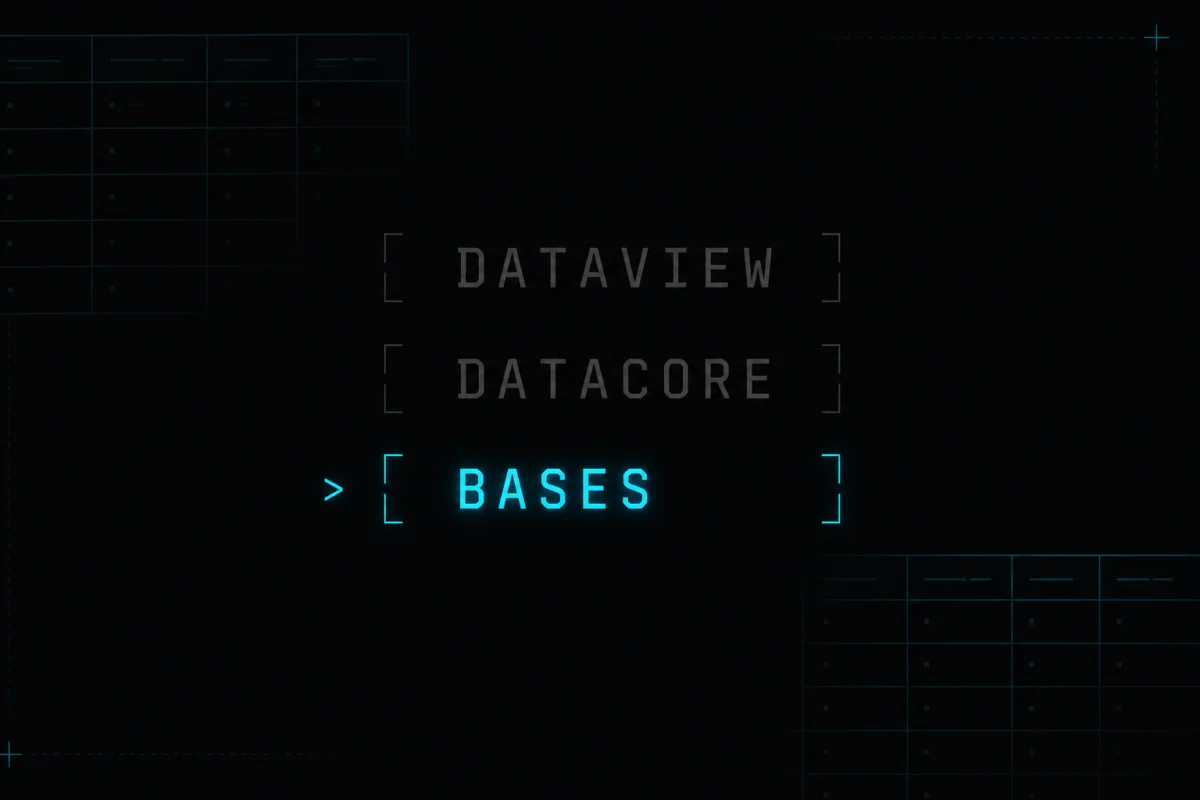
Dataview vs Datacore vs Bases: what I actually use in 2026
I open Obsidian every single day. Not for pretty notes. I run my whole operation out of it: every blog draft, every client project, every asset I've made. And the thing that holds it all together isn't folders. It's a query.
For years there was one way to do that in Obsidian, and it was Dataview. Now there are three. A year ago the honest answer to "which one" was "wait and see." That answer is dead. Here's what I reach for now, and exactly when.
What changed since the hype
Back in mid-2025 the story was simple. Dataview was the stable king, Datacore was the fast newcomer, and Bases was a promising beta from the Obsidian team that could only do tables and only read note properties.
Two of those three sentences are now wrong.
Bases shipped. It's a core plugin now, built into the app, no install needed. It launched with table and card views in Obsidian 1.9, then added list and map views in 1.10. Search inside a Base is on the roadmap for 1.12. So the old "it only does tables" knock? Gone. The "you have to install a plugin" friction? Also gone.
That one shift changed my whole setup. Let me walk through all three.
Dataview: the one that started it
Dataview came out in 2021 and the community lost its mind, for good reason. It's one of the most-downloaded Obsidian plugins ever, north of three million installs. You write a little query, you get a live list or table of notes back. Something like:
LIST FROM #project WHERE status = "active"
That's it. Readable. Anyone can pick it up in an afternoon.
I have a soft spot for Dataview. It taught the whole community why querying your notes matters. But I've hit its walls, and so has everyone with a big vault.
It's slow. Not "broken" slow, but on a large vault it drags, and the query language was never built for speed. On my phone it used to add a second or two to load time, sometimes more. You've seen the effect even if you didn't name it: you open a note and the content jumps around for a beat while Dataview renders. That shuffle is Dataview thinking.
The bigger problem is that it stopped moving. The main developer went quiet on it a long time ago. No real updates. That's not automatically bad, a stable tool is a stable tool, but when your two rivals ship improvements every few weeks, standing still is falling behind.
And Dataview only shows you data. You can't do much with it. View, don't touch. For a lot of people that's fine. For me it stopped being enough.
If you want something that works today, with zero risk and a friendly syntax, Dataview is still a fair pick. It's the only one of the three that isn't beta or brand new. Just know you're buying into a tool that won't grow.
Datacore: the power option that asks a lot
Datacore is the sequel, from the same developer who built Dataview. The whole point is to fix the two things Dataview couldn't: speed and interactivity.
On speed, it delivers. Datacore feels native. That content shuffle I mentioned? It mostly disappears. You open a note and the view is just there. It claims a few times the query and render performance of Dataview, and in daily use it holds up.
It's also interactive in a way Dataview never was. You can edit properties, create notes, build real components, straight from the view. Think closer to Notion or Airtable than a static list.
Here's the catch, and it's a big one. Datacore drops the friendly query language and hands you React instead. You build views as components in JavaScript. That's enormous power if you're a developer. It's a brick wall if you're not. Dataview you learn over coffee. Datacore you learn over a weekend, and only if you already know React.
It's still in beta after years of work, and it isn't in the community plugin store yet. You install it through BRAT, the beta plugin loader. So it's not something I'd hand to a non-technical client.
My read: Datacore is going to win on reusable components. Someone builds a slick interactive dashboard once, ships it, and the rest of us drop it in and tweak the config. That's where the React cost pays off. For one-off queries, it's too much.
Bases: the one I run my vault on
Bases is the Obsidian team's own take, and you can feel the difference. It's fast. Not "fast for what it is," just fast. You build a view, it updates instantly, results come back quicker than either alternative. In my testing it beats Datacore on raw speed, without asking me to write a line of code.
That last part is the whole game. No query language, no React, none of it. You build a Base in a visual editor: pick your notes, add filters, choose columns, done. It reads your note properties (the frontmatter at the top of a file), plus file data like created date and folder, plus formulas you define.
A Base lives in a .base file, which is just YAML under the hood, so it's still plain text you own and can diff in git. You can drop one into any note as an embedded block too.
It has limits. It queries structured data, so if a fact isn't in a property, a Base can't see it. And it's newer, so it's still filling in features. But for the shape of work I do, it's the right tool, and it's the one I open most.
How I actually map my vault with Bases
This is the part the comparison posts skip. Here's my real setup.
I keep three Bases pinned, and they run my week:
- Blogs. Every draft is a note with
status,platform, andpublishedproperties. One Base shows me everything that's drafted but not live, sorted by date, as a table. I glance at it and know what's next to ship. When I finish this post, it drops off the list on its own. - Projects. Each project is a note with
stage,client, andtype. A card view groups them by stage, so "design," "awaiting sign-off," and "shipped" are their own columns. It's a kanban board I never had to build. It updates the second I change a property. - Assets. Every image, script, and generated file gets a note with a
kindand a cover image. The card view with cover images turns it into a visual library. I stopped losing things I made three weeks ago.
None of this needed code. I set the properties once, described what I wanted to see, and Bases did the rest. When I add a new blog or start a new project, it appears in the right place automatically. That's the payoff: the vault organizes itself, and I just keep writing.
If you're curious how the whole system fits together, I wrote about running Claude, Cowork, and Obsidian as my second brain, and Bases is the layer that makes the notes queryable.
So which one should you use
Short version, no fence-sitting:
Use Bases for almost everything. It's built in, it's fast, and the visual editor makes it quick to build and quicker to change. If you're not writing code, this is your answer, full stop. It runs my blogs, projects, and assets and I haven't wanted more.
Use Datacore when you need a genuinely interactive component and you're comfortable in React. Reusable dashboards, edit-in-place tables, the fancy stuff. It's the specialist you call in.
Use Dataview if you want something proven right now and you like the query language, or you already have queries you don't want to rewrite. Just accept it won't improve.
I moved the bulk of my vault to Bases over the last few months and haven't looked back. Dataview walked so this could run.
What to do next
Open your Obsidian settings, turn on the Bases core plugin, and build one view. Start with your projects or your notes tagged a certain way. Give a few notes some properties, describe what you want to see, and watch it populate. Fifteen minutes and you'll get why I run my whole vault this way.
If you'd rather have someone build the querying and automation layer for you, or you want a custom Obsidian plugin for your team, that's the kind of thing I do. Take a look at my Obsidian plugin development work, or just tell me what you're trying to organize.
Last updated 19 Jul 2026 · filed under Plugin, tools, obsidian